
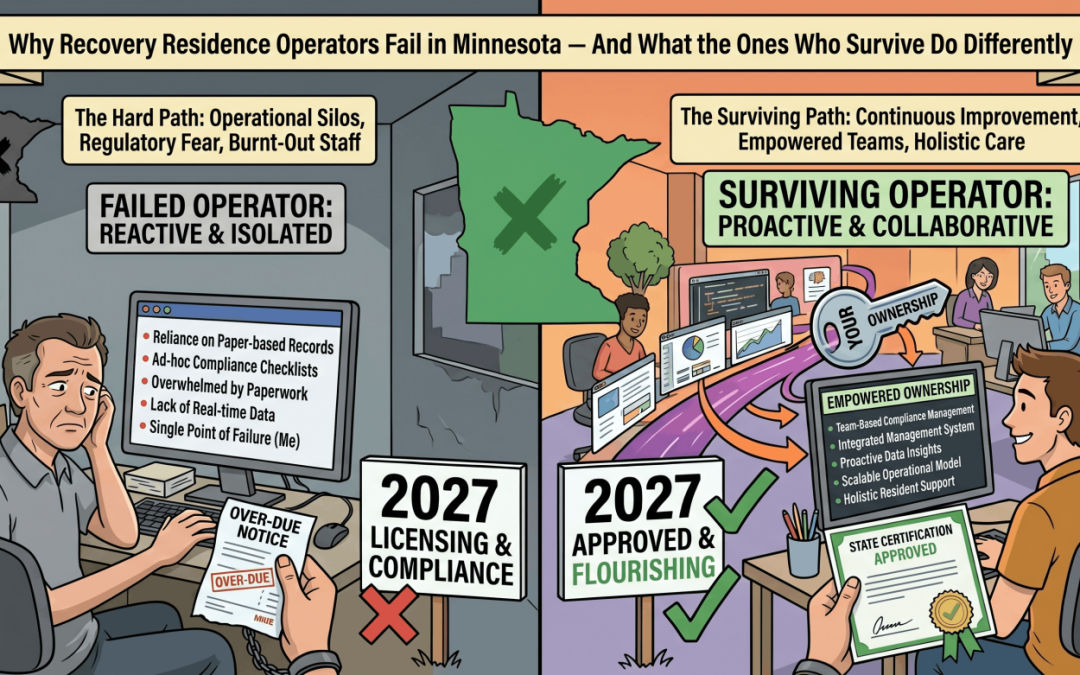
Minnesota’s recovery housing landscape is littered with cautionary tales. Some of them involve fraud. Some involve good intentions and no infrastructure. Some involve operators who got the land use approval, produced the architectural drawings, hired the lawyers, and then discovered that none of that is the same as actually operating a compliant recovery residence.
The pattern repeats with enough consistency that it is worth examining directly. Because every failure in this space has a human cost that does not show up in the court filings or the DHS termination letters. It shows up in the lives of residents who lose stable housing mid-recovery.
Aggate Properties exists to prevent that outcome. We are not a software company. We are not a staffing agency. We are a consulting firm that has spent twenty years building the compliance infrastructure, technology systems, and organizational documentation that mission-driven organizations need to operate at the level government funding programs require. We built our turnkey recovery residence platform directly to the Minnesota DHS 254B.211 standard because we watched what happens when operators try to piece that infrastructure together on their own under deadline pressure. The results are not good.
The following is not written to embarrass anyone. It is written to make the pattern visible so that operators who are heading in the wrong direction can course-correct before their residents pay the price.
What Aggate Properties Builds
We are twenty years into building the infrastructure that mission-driven organizations need to operate at the level government programs require. We built the platform that powers a Twin Cities recovery residence operator recently — a public-facing WordPress website, a CiviCRM case management system with a documented resident record trail, a complete 254B-aligned policy and procedure manual, all required forms and postings, and managed AWS cloud hosting. Open source stack. No vendor lock-in. No per-seat licensing. The operator owns everything on day one.
When your infrastructure is open source and hosted on your own AWS environment, no company closure takes your data with it. Your resident records are yours. Your compliance documentation is yours. Your operational history is yours.
The policy and procedure manual we build covers all 21 points of the DHS 254B.211 checklist — not a generic sober home template adapted to Minnesota, but a document suite drafted against the actual statutory requirements. Resident Bill of Rights. Financial obligations disclosures. Emergency procedure orientation. Relapse policy. Medication storage policy. Opiate antagonist supply and training documentation. Incident reporting system. Grievance procedure records. All of it built to survive a DHS inspection and all of it integrated into the technology platform so that documentation events are captured automatically rather than depending on staff memory.
We also build the nonprofit organizational structure for operators who need it — 501(c)(3) filings, board governance frameworks, grant application infrastructure, donation programs. The compliance work and the organizational work are not separate problems. They are the same problem approached from two ends.
The Question Every Operator Should Answer Today
If DHS walked into your recovery residence tomorrow with a compliance review checklist, could you open a file and demonstrate that every resident who moved in this year received a signed copy of the resident bill of rights on their first day? Could you show a documented opiate antagonist training log? Could you produce background study filings for every person with ownership stake, operational authority, or direct resident contact? Could you show a complete incident report trail for every event that occurred in the last twelve months?
If the answer to any of those questions is no, or I think so, or we do that but not always in writing — you have a compliance gap. That gap is the difference between certification and displacement. It is the difference between a Housing Support Program agreement and a funding cliff. It is the difference between your residents having stable housing on January 2, 2027 and your residents being the next KARE 11 story.
You do not have to be the next cautionary tale. The infrastructure exists. The platform is built. The deadline is seven months away.
This article is for general information and reflection. It is not professional advice. For your specific situation, consult a qualified professional.